

How much content can I publish each week without wrecking my editor’s schedule or my freelancers’ quality? It comes down to three numbers, not a target copied from a competitor’s posting calendar: the editorial hours your team actually has, the average hours one piece consumes from brief to final read, and the revision rounds baked into that average. Divide available hours by hours-per-piece and the answer is a number you can defend, not a guess. Most teams undercount the review step, and review, not writing speed, is usually the real ceiling.
The question behind the question
“How much content can I publish” almost never shows up on a quiet week. It shows up when the queue has stalled, a founder wants more volume, or a new writer just joined and nobody knows what that changes. Answering it as an ambition question (“we should do more”) produces a number nobody can hold past a month. Answering it as a capacity question produces a number that survives a bad week.
The distinction matters because the two questions get different answers. Ambition asks what would be impressive. Capacity asks what your current hours, current tools and current review process can actually carry through to a published page, every week, not just the good ones.
How much content can I publish? The formula
Here is the math, using round numbers you should replace with your own: available editorial hours per week, divided by hours per piece, equals your defensible weekly capacity.
Say your team has 20 combined editorial hours a week across writing, editing and final review. If a typical piece takes 4 hours end to end, including one revision pass, your weekly capacity is 5 pieces. If the same piece actually takes 6 hours once you count a second round of edits, capacity drops to roughly 3. The formula does not change; the honesty of the hours-per-piece number does.
Two mistakes distort this number almost every time. First, teams count only writing time and leave out briefing, fact-checking and the editor’s read-through, which can easily double the real hours per piece. Second, teams measure hours-per-piece from their best writer’s best week, not the average across a real month with a sick day, a late freelancer or a piece that needed a full rewrite. Measure the last eight weeks of actual output, not the plan, and divide by the weeks. That number, not a wish, is your starting capacity.
Why your CMS is part of the capacity number
The tool your writers publish through is not separate from this math, it is an input to it. A content management system that forces a non-writer to touch code, fix broken formatting, or wait on a developer to push a change adds hours to every single piece, quietly, before anyone notices the pattern. Before assuming your capacity problem is a hiring problem, run the one-hour test for whether a non-developer can actually publish on your platform: if a writer needs help to get a finished draft live, that dependency is eating capacity every week, not just on migration day.
The same applies to how much developer time your stack demands to keep running. If every plugin update or broken build routes through one person’s calendar, that person’s availability caps your publishing rate whether or not they touch a single article. An honest look at whether you need a developer on call is worth doing before you add another writer to a workflow that is already bottlenecked somewhere else.
The hidden bottleneck is revision, not writing speed
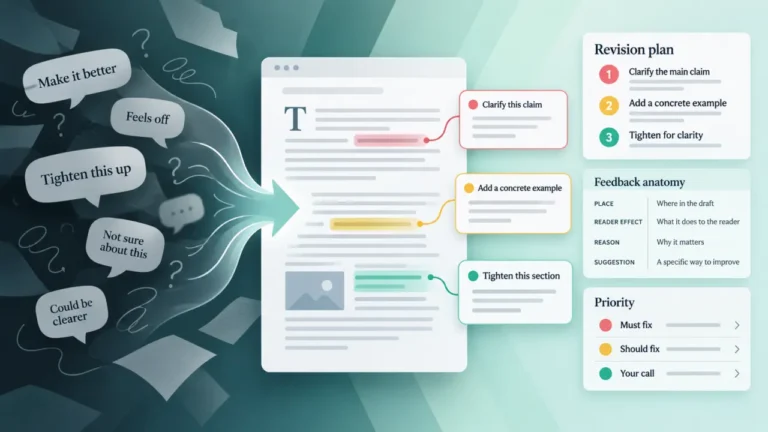
Ask most small teams why an article took longer than planned, and the answer is rarely “the writer was slow.” It is usually a second or third revision round caused by a brief that was too vague, a style question that got relitigated for the third time that month, or an editor waiting on an answer from someone else before they can sign off.
Revision rounds are also the part of the process most people forget to count when they estimate hours-per-piece. A first draft in two hours followed by two rounds of back-and-forth edits over three days is not a two-hour piece; it is a five- or six-hour piece with a multi-day tail, and that tail is what actually caps a weekly publishing number.
What the research says about frequency versus quality
It is tempting to treat “publish more” as the whole answer, and the traffic data does support a real relationship between frequency and results. HubSpot’s blogging-frequency benchmarking, read September 18, 2026, found that businesses publishing 16 or more posts a month saw roughly 3.5 times the traffic of those publishing weekly or less often, and close to 4.5 times the leads of businesses publishing zero to four posts a month. That is a real, cited correlation, not a marketing slogan.
The same body of research also carries a caution worth taking seriously: publishers that pushed volume without keeping editorial quality and topical focus intact have seen traffic fall even while output stayed high. In other words, the frequency number only pays off inside a capacity number that still has room for review. A calendar that hits 16 posts a month by skipping the edit pass is not the same calendar the benchmark describes.
What editorial time actually costs
Once you know your hours-per-piece, it helps to know what those hours are worth, especially if any of them are freelance. The Editorial Freelancers Association’s rate chart, read September 18, 2026, lists typical copyediting rates in the range of about $0.02 to $0.05 per word, or roughly $35 to $65 an hour, with developmental editing running higher again given the depth of the work. Multiply that against your actual hours-per-piece, not your planned hours, and the true cost of a publishing schedule usually comes out higher than the number used to set the freelance budget.
That gap between planned and actual cost is exactly the kind of thing that surfaces later rather than up front. It is the same pattern covered in the costs that tend to appear around month six of running a content operation, where the line items that were assumed to be fixed, like editing time or platform overhead, turn out to scale with volume in ways nobody priced in at the start.
A one-page style guide buys back hours
The single cheapest fix for an unrealistic capacity number is removing repeat arguments from the revision cycle. A one-page editorial style guide that settles tone, formatting and the handful of house rules that keep coming up in edits will not make anyone write faster, but it will cut the number of revision rounds a typical piece needs, which is the actual lever behind hours-per-piece. Teams that skip this step usually rediscover the same three style disagreements every month, on every writer’s draft, at the cost of an editing pass each time.
Setting a number you can actually hold
Once you have a real hours-per-piece figure, set your weekly or monthly publishing target below the math, not at it. A calendar built at the exact ceiling of your capacity has no room for a slow week, a sick writer or a piece that needs a full rewrite, and the first bad week either breaks the schedule or breaks the quality bar.
Run the reduced number for four weeks, track what actually goes live against what you planned, and adjust from there. If you consistently beat the plan with room to spare, raise it by one piece and hold that for another month before raising it again. Capacity planning is not a one-time calculation; it is a number you recheck every time your team, your tools or your review process changes.
FAQ
How much content can I publish per week with one editor?
There is no fixed number that applies to every team; it depends on how many hours that editor has for review each week and how many revision rounds your average piece needs. Divide the editor’s available review hours by the hours each piece typically takes them to review, and that is your real ceiling, independent of how fast the writers draft.
Does publishing more content always improve SEO?
Not on its own. Higher-frequency publishers do show measurably higher traffic in aggregate benchmarking, but the same research shows that volume without sustained editorial quality can lose that advantage. Treat frequency as one input alongside quality, not a target to hit regardless of what it costs the review step.
How many revision rounds should a piece need before I treat it as a capacity problem?
One planned revision round is normal and should already be counted in your hours-per-piece figure. If a piece routinely needs a second or third round for the same recurring reasons, such as tone or formatting disagreements, that is usually a missing style guide problem, not an individual writer problem.
What’s the fastest way to raise my publishing capacity without hiring?
Cut revision rounds before adding people. A one-page style guide, a clearer brief template and a CMS that does not require developer help for routine edits typically free up more hours per piece than a new hire adds, and they cost nothing to run once they are in place.
A publishing capacity number is only useful if it is honest about the hours a piece actually takes, review included. Measure it from what went live over the last two months, not from what you planned, set your target a step below it, and adjust the number every time something about your team or your tools changes.