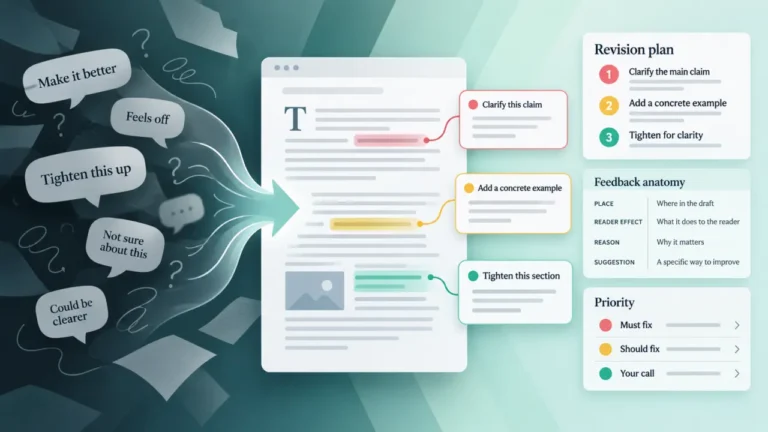


You open a colleague’s draft meaning to tidy it. An hour later most of the sentences are yours, the writer feels overruled, and their next draft will have the same problems, because nothing told them what the problems were.
To edit another writer’s draft without rewriting it, read it once without changing anything, then edit in passes from the biggest problems to the smallest: does it do what the brief asked, is the structure right, are the facts right, and only then the sentences. Fix what is wrong, ask about what is unclear, and leave alone anything that is merely different from how you would have written it.
That last sentence is the whole method. The rest of this page is how to apply it on a team where the editor and the writer will work together again next week.
Why editing turns into rewriting
Rewriting rarely starts as a decision. It creeps in for three reasons.
There is no standard to edit against. Without a brief and a style guide, the only reference is the editor’s own taste, and every sentence that does not match it looks like a mistake.
The editor starts at the sentence level. Sentences are the most visible part of a draft, so they get fixed first. Then a structural problem surfaces on page three, whole sections move, and the polished sentences get thrown away or rewritten again.
Fixing feels faster than explaining. For one article, it is. Across a year it is the slowest option there is, because the writer never learns what to change and the editor fixes the same problems forever.
How to edit another writer’s draft: the pass order
Editing in passes means each read-through looks for one kind of problem. It feels slower. It is faster, because nothing gets fixed twice.
| Pass | Question | What you do |
|---|---|---|
| 0. Read | What is this trying to do? | Read start to finish. Change nothing. Note your first reactions as a reader |
| 1. Brief | Does it answer the question it was commissioned to answer, for the intended reader? | If not, stop. It goes back to the writer |
| 2. Structure | Is the order right? Is anything missing or surplus? | Mark moves and gaps. Do not rewrite sections |
| 3. Accuracy | Is every claim, name, number and link right? | Correct factual errors. Query anything you cannot confirm |
| 4. Clarity | Does each paragraph make its point? | Question unclear passages. Suggest, do not replace |
| 5. Line | Sentences, style guide, consistency | Edit directly, lightly, in the writer’s voice |
The order is not arbitrary. George Mason University’s Writing Center, in its guidance on providing feedback to writers (read September 11, 2026), makes the point that when writers are going to revise, “it doesn’t make much sense to edit prose that they are going to rewrite.” Polishing sentences in a section that is about to move is work you will do twice.
Pass 0 matters more than it looks. The first read is the only time you experience the draft the way a reader will. Once you start marking it up, you are reading as an editor, and you lose the ability to notice where a reader would get bored or lost. Write those first reactions down; they are the most valuable notes you will make.
Pass 1 can end the edit. If the draft answers the wrong question, nothing else is worth doing yet. Send it back with one clear note about what the brief asked for, and save everything else for the next draft.
Wrong, unclear, or just different
This triage is how the rewrite trap is avoided in practice. Before you change anything in passes 3 to 5, put it in one of three boxes.
| Box | Test | Action |
|---|---|---|
| Wrong | It is inaccurate, breaks the style guide, or will mislead a reader | Change it, and if it is a pattern, say so in your summary |
| Unclear | You are not sure what the writer means | Ask a question in a comment. Do not guess and rewrite |
| Different | It is correct and clear, just not how you would put it | Leave it |
The third box is the hard one. Most rewriting is “different” edits dressed up as “wrong” ones. If you cannot name the rule a sentence breaks or the reader problem it causes, it probably belongs in the third box.
A written style guide shrinks the arguments over the third box, because it turns taste into a rule both of you can see. If your team does not have one, a one-page editorial style guide for a blog is enough to settle most disputes before they start.
Decide how deep the edit goes before you open the file
Not every draft needs every pass. Agree on the depth of the edit with the writer, or at least decide it yourself, before you begin.
- Structural edit for an early draft, a topic that is new to the writer, or a loose brief. Passes 1 and 2 only, then back to the writer for revision.
- Full edit for a complete draft on a familiar topic. Every pass, in order.
- Light edit for an experienced writer on a routine piece. Passes 3 and 5, with anything bigger raised as a question rather than changed.
Deciding the depth up front stops a light edit from sliding into a rewrite, which is how most rewrites begin.
When to hand it back instead of fixing it
A simple rule: if fixing the problem means changing the draft’s main point or reorganizing more than one section, the writer does the fixing.
Return the draft with a short note that names the problem, points to where it shows up, and says what the revised draft needs to do. Then leave it alone. The writer will produce a better second draft than you would produce from their first, because they know what they meant to say.
The exceptions are real, and it is better to name them than pretend they do not exist:
- A hard deadline with no time for another round.
- A factual or legal problem that has to be fixed before anything else can happen.
- A writer who is no longer available.
In each case, rewrite if you must, but tell the writer what you changed and why. A silent rewrite teaches nothing and costs trust.
Mark a pattern once, not every time
If the same problem appears twenty times, twenty marks bury it. Miami University’s Howe Center for Writing Excellence, in its guidance on giving feedback to writers (read September 11, 2026), advises “don’t mark all surface errors.” That advice was written for teaching, and it transfers directly to an editorial team.
In practice: fix or mark two or three clear instances, then say in your summary that the pattern recurs and ask the writer to find the rest. They learn more from finding them than from reading your marks, and your edit stays readable.
Where the edit happens matters
Edits the writer cannot see are edits the writer cannot learn from. Whatever tool you use, the writer should be able to see every change and every question, not only the finished version.
- Suggestion mode in a shared document keeps each change visible and reversible.
- Comments carry the questions and reasons that do not belong in the text.
- In a Git-based CMS, edits often arrive as a reviewed set of changes; how pull-request review works for content teams looks at whether that suits writers.
The tool matters less than the rule: no invisible edits. If your CMS makes it hard to see who changed what, weigh that the next time you pick a platform. Choosing a CMS for a content team starts from exactly this kind of question: who does the work, and how.
Leave a summary, not just marks
Marks in the margin tell the writer what changed. A short summary tells them what to learn from it.
Keep it to a few lines:
- What works, specifically, so it survives the next draft.
- The one or two patterns behind most of your edits.
- Anything you changed directly that the writer should know about.
- Open questions that need an answer before the piece can go forward.
What the writer should be able to do next time
The test of a good edit is not the article you publish. It is the next draft the same writer hands you.
If that draft has fewer structural problems and the same patterns are not coming back, the edit worked. If you find yourself making the same changes every time, the edit is not teaching anything, and the fix is upstream: a clearer brief, a new style guide rule, or a conversation, not a heavier edit.
FAQ
How do you edit someone else’s writing without changing their voice?
Change only what is wrong: inaccurate, against the style guide, or confusing to a reader. Ask about anything unclear, and leave choices that are simply different from yours. Do the line edit last, and keep it light.
Should I rewrite a draft that needs a lot of work?
Usually not. If the main point or the structure has to change, return it to the writer with a clear note. Rewrite only for a hard deadline, a factual or legal problem, or a writer who is unavailable, and tell them what you changed.
What order should I edit a draft in?
Read it once without changes, then check it against the brief, then structure, then accuracy, then clarity, then sentences. Fixing sentences before structure wastes work, because sections that move usually get rewritten anyway.
Should I fix every typo and repeated mistake I see?
Fix them in the final line pass. For a mistake that repeats, mark a few instances and name the pattern in your summary so the writer can find and fix the rest.
Edit to make the article right, not to make it yours. The writer’s next draft will show whether you managed it.