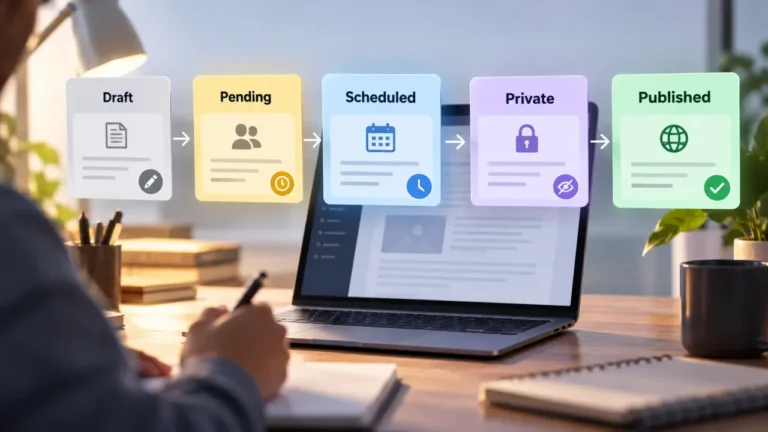


Content status tracking is the practice of recording, in one place both writers and editors already check, what stage every piece is in right now: not started, drafted, in review, approved, or scheduled. A small operation does not need a dedicated project tool to do this. A single shared document with five fields, updated the same way every time, covers a team of two to eight people. The failures that actually happen, an article gone quiet for three weeks, a freelancer asking “is this still needed,” an approval nobody remembers giving, come from missing fields and unclear ownership, not from the absence of software.
What Content Status Tracking Has to Answer
There is exactly one test that matters: can anyone on the team find out, in under a minute and without asking a person, what stage a specific article is in and who is holding it right now.
Most systems that fail were never built against that test. They were built to look organized, with more columns than anyone updates and a status list nobody agreed on the meaning of. A tracker with eleven possible statuses is worse than one with four, because the eleventh status is where things go to be forgotten. The purpose of the record is to answer one question fast, for someone who is not the person currently doing the work. Everything else, reporting, forecasting, workload balancing, is a later problem, and building for it first is why so many trackers get abandoned inside a month.
The Fields That Matter, Whatever You Hold Them In
Five fields do the job, and the medium underneath them is close to irrelevant.
Title. Not a working title that changes twice, the string that will actually identify the piece to everyone who touches it.
Stage. A short, fixed list: agreed, drafted, in review, approved, scheduled or published. Four to six options, never more. Every extra stage is a place work can sit unowned.
Owner. One name, the person currently responsible for moving it forward. Not “the team,” not two names. If two people could plausibly be the owner, the piece has no owner.
Date it entered this stage. Not the due date, the date it arrived here. A piece that has been “in review” for eleven days is a different problem than one that arrived yesterday, and a tracker with only a due date cannot tell the two apart.
Next action. One line describing what has to happen for the stage to change. If nobody can write this line, the piece is stuck for a reason nobody has named yet.
That is the whole schema. It fits in a spreadsheet, a shared document with a table, or a plain list, and it fits without a database, an integration, or a subscription.
Where to Keep It When You Are Not Buying Anything
The honest answer is that where you keep it matters less than whether everyone opens the same copy. A shared spreadsheet works. A single shared document with a table works. The choice that actually breaks systems is a second copy: an editor’s private list that duplicates the shared one, updated on a different schedule, is worse than no list, because it creates two versions of the truth and nobody knows which one is current.
One thing is worth noticing before you build anything extra: your CMS almost certainly already tracks two of the five stages for free, once a piece exists inside it. A draft that becomes “published” or moves to a scheduled date is a status change your platform already records without you maintaining a second copy of that fact. The manual tracker only earns its keep for the stages before that: agreed, drafted, and in review, which is where most stalls actually happen, since almost nothing gets stuck between “scheduled” and “published.”
Where Freelancers Fall Through
A freelance writer is usually the person with the least visibility into whatever tracker you keep, and that gap is where status tracking most often fails in practice.
The pattern is consistent: a freelancer delivers a draft, hears nothing for a week and a half, and eventually asks whether the piece is still wanted. Nobody lied to them. The article moved through review and stalled in approval, and the freelancer was simply never told, because the tracker lived somewhere they did not have a login for.
The fix is not to give every freelancer admin access to an internal system. It is to name one person who owns telling freelancers where their piece stands, and to do it at the moment the stage changes rather than when the freelancer asks. That single habit, one owner, one message, at the moment of change, closes most of the gap. It is worth checking early whether the freelancer can see their own piece’s status at all without pinging someone: it is close to the same question this site asks about a non-developer publishing unaided, just applied to visibility instead of the publish button. If the answer is no on both counts, every status update becomes a manual handoff, and that cost scales with how many freelancers you use.
The One Rule That Keeps a Manual System Honest
Exactly one person updates the status field for a given piece, and it happens at the moment the stage actually changes, not reconstructed from memory at the end of the week.
Two people updating the same tracker, even with good intentions, produces two versions of events within a month: one person marks something “approved” from a hallway conversation, another marks it “in review” because they still have edits pending, and now the record is wrong for whoever checks it next. The rule is simple to write down and easy to break under time pressure, which is exactly why it needs to be a written rule rather than an assumed one.
When Tracking by Hand Starts Costing More Than It Saves
A spreadsheet handles the volume most small teams actually publish. The point where it stops working is not a fixed number of articles, it is the point where checking status starts taking longer than doing the work it is supposed to speed up.
Digital Applied’s 2026 content operations research (read 2026-09-18) found that in manual, tool-light review workflows, a typical piece has a turnaround of roughly 4.7 days, but editorial review and final quality checks account for only about one day of that combined. The rest of the time is status-chasing, waiting on a stakeholder, and re-routing work that stalled without anyone noticing. That gap between the actual work and the waiting around it is the number worth watching in your own operation. If you find yourself asking three people where something is before you get an answer, the manual system has already started costing more than the ten minutes it would take to write the status down properly. The same pattern shows up on the platform side, too: a setup that was free to run at low volume is rarely free once volume grows, which is the exact shape of the costs that appear in month six on a platform, not just a tracker.
Writing the System Down So It Survives Turnover
The five fields and the one-owner rule belong on paper, or at least on one page, not in the head of whoever set the system up. When that person is out sick, or leaves, an unwritten system disappears with them and the team reinvents a worse version within a month.
This does not need its own document. It fits as one section inside a one-page editorial style guide, next to whatever else your team has already agreed to write down. A tracking system with no written definition of what each stage means is a system where two people will eventually disagree about whether something counts as “in review,” and there will be no page to settle the argument.
Deciding When to Add a Tool
A spreadsheet or shared document is not a permanent choice, it is the right choice until a specific, named problem outgrows it. The signal is not a headcount or a monthly article count on its own, it is whether the one-minute test from earlier still passes: can anyone find out a piece’s stage and owner in under a minute, without asking a person. When the answer becomes “no” reliably, that is the point to look for something more structured, not before.
One thing worth checking before adding anything new: whether the change you actually want, say, a status field that also moves a draft somewhere automatically, requires custom setup work or not. Whether keeping something like that running needs a developer is worth answering honestly before committing to it, because a system that needs a developer’s time to maintain a status field has traded one kind of friction for another, not removed friction.
The Short Version
- Content status tracking only has to answer one question fast: what stage is this in, and who is holding it.
- Five fields cover it: title, stage, owner, date it entered this stage, and the next action.
- Where you keep it matters less than whether everyone opens the same copy. A second, private copy is worse than none.
- Your CMS already tracks the later stages for free; the manual record earns its keep on the earlier ones.
- Freelancers fall through because they cannot see the tracker. Name one owner for telling them at the moment status changes.
- One person updates a given piece’s status, at the moment it changes. Two updaters produce two versions of the truth.
- Write the system down in one page so it survives someone leaving.
- Add a tool when the one-minute test starts failing reliably, not before.
FAQ
Do I need special software to track content status?
No. A shared spreadsheet or a shared document with a table covers a team of two to eight people, provided everyone opens the same copy and one person updates a given piece’s status at the moment it changes.
How many status stages should a small team track?
Four to six: agreed, drafted, in review, approved, and scheduled or published. More than that creates places where work sits unowned and gets forgotten.
Why do freelance writers fall through the cracks even when a tracker exists?
Because the tracker usually lives somewhere they do not have access to. Nobody lies to them, the piece simply stalls in review or approval and nobody tells them, since the status change happens in a system only staff can see.
What is the biggest failure mode in a manual tracking system?
Two people updating the same record from memory. It produces two versions of what actually happened within weeks, and whoever checks the tracker next cannot tell which one is current.
When should a small team stop using a spreadsheet for status tracking?
When the one-minute test fails reliably: when someone can no longer find a piece’s stage and owner without asking a person first. That point is about workflow friction, not a fixed number of articles per month.